Returning from the Summit: Enduring Lessons from RevUP 2025
The RevUp 2025 Summit, organized by the Professionals for Association Revenue, is the premier conference for association professionals exploring...

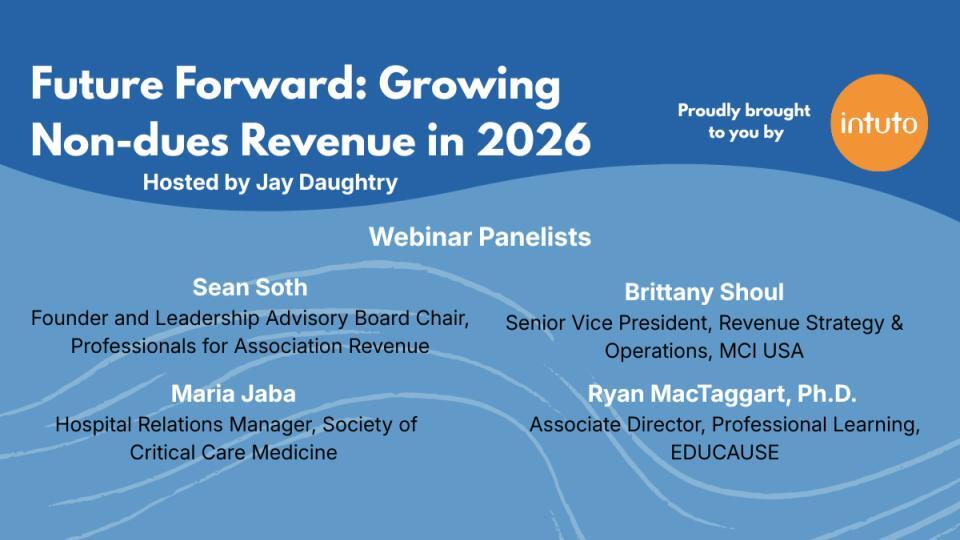
In Part 2 of our series following up from the RevUp 2025 Summit, organized by the Professionals for Association Revenue, we brought together another panel of experts to look at the non-dues revenue trends to look for in 2026.
Hosted by Jay S. Daughtry, M.Ed. this panel of industry leaders deconstructed how high-performing associations are driving non-dues revenue by moving away from "ticky-tacky" products and toward deep, high-touch partnerships.
Joining Jay on the panel we were delighted to host:
🎙️ Maria Jaba, The Society of Critical Care Medicine (SCCM)
🎙️ Ryan MacTaggart, EDUCAUSE
🎙️ Brittany Shoul, MCI USA
🎙️ Sean Soth, Professionals for Association Revenue (PAR)
1. Where should associations focus their event strategy?
The "big hall" trade show isn't dead, but the momentum is shifting to small-format, high-intent events. Brittany noted that sponsors are now willing to pay more for a smaller room if it contains the right decision-makers engaging in real dialogue.
The Trend: Symposiums and "reverse trade shows" where matchmaking is curated.
The Why: People are craving human interaction that isn’t recorded or transcribed by an AI.
2. How is AI actually helping (and not just hype)?
AI is being leveraged to speed up content development and provide better insights through analytics to identify new revenue opportunities.
Strategic Use: Maria highlighted AI’s role in personalized learning and building stronger partner relationships by delivering measurable value faster.
The Counter-Trend: As AI makes digital content ubiquitous, the value of in-person, unrecorded "intimate dialogue" increases.
3. What is the "Pathway" concept for sponsorship?
Sean introduced a shift from one-off "January to December" buys to Initiative-Based Invitations. Instead of selling a single ad, associations are inviting partners to join a "Pathway" that might include micro-events, articles, and podcasts that culminate at the annual meeting.
The Benefit: It creates urgency. Partners can join the pathway at any time, and the engagement becomes multi-year rather than a timestamped transaction.
The most provocative takeaway from the session was the distinction between Return on Investment (ROI) and Return on Engagement (ROE).
ROI is transactional: "I spent X, I want Y back."
ROE is relational: It measures the depth of the engagement over time—multiple touchpoints, relationship building, and prestige.
Top 3 Takeaways for Your 2026 Strategy
Revenue is not an afterthought: Stop building programs and then asking how to monetize them. Revenue potential should be baked into the program design and content strategy from day one.
Move from Vendor to Thought Leader: Shift your corporate partners away from "sales pitches" and invite them to be experts for the community. This resonates better with members and builds long-term loyalty.
Leverage the C-Suite: The sales process shouldn't sit in a silo. Use your Executive Director and C-suite leaders to embed revenue strategy into key partner conversations. This opens more doors than any individual product.
"If there's alignment across the entire organization... that's where you're finding non-dues revenue.
Below we've selected three snippets from the webinar that answer some of the most asked about non-dues revenue questions as associations look to lock in their 2026 strategy.
If you're interested in finding out about our future webinars be sure to follow us on Linkedin. If you have a topic you'd like us to explore or if you'd like to join one of our panel discussions please reach out, we'd love to hear from you.
The RevUp 2025 Summit, organized by the Professionals for Association Revenue, is the premier conference for association professionals exploring...

For nearly every association, the mandate is clear: find ways to create new revenue streams. According to a 2023 report, a significant portion of...
If you’re a Learning Manager, you’re likely familiar with "the spreadsheet."